
Homeschooling the System-Compatible Child
This sponsored post is in partnership with Crimson Global Academy.
There is a distinction I think more parents need language for— what if my child is a system compatible learner?
The child we don’t talk about enough
There is a version of homeschooling that gets the most attention—the independent child, the self-directed learner, the one who thrives the moment structure is removed.
And for some children, that is absolutely true.
But not for all of them.
There is another kind of learner—one who doesn’t resist structure, but settles into it. A child who finds clarity in expectations, who moves forward when there is a clear path, and who doesn’t feel limited by a framework but supported by it. A child who doesn’t need less guidance, but better guidance.
That child rarely gets centered in the homeschool conversation. And yet, that is the conversation that has been unfolding in our home this year.
When homeschooling isn’t about freedom alone
Homeschooling is often framed as freedom, and in many ways, it is. But freedom was never meant to mean the absence of structure. It was meant to give us the ability to choose the right kind of structure for our children and families.
In our home, homeschooling high school made that clear quickly.
The questions shifted. The stakes felt different. It was no longer just about rhythm or curiosity—it became about direction, momentum, and confidence in what comes next.
As a former school principal, I understand how the system works. I also understand where it begins to fall short. But as a mother, what has become even clearer to me is this: removing structure isn’t the goal.
Alignment to meet your child is.
System-dependent vs. system-compatible
There is a distinction I think more parents need language for.
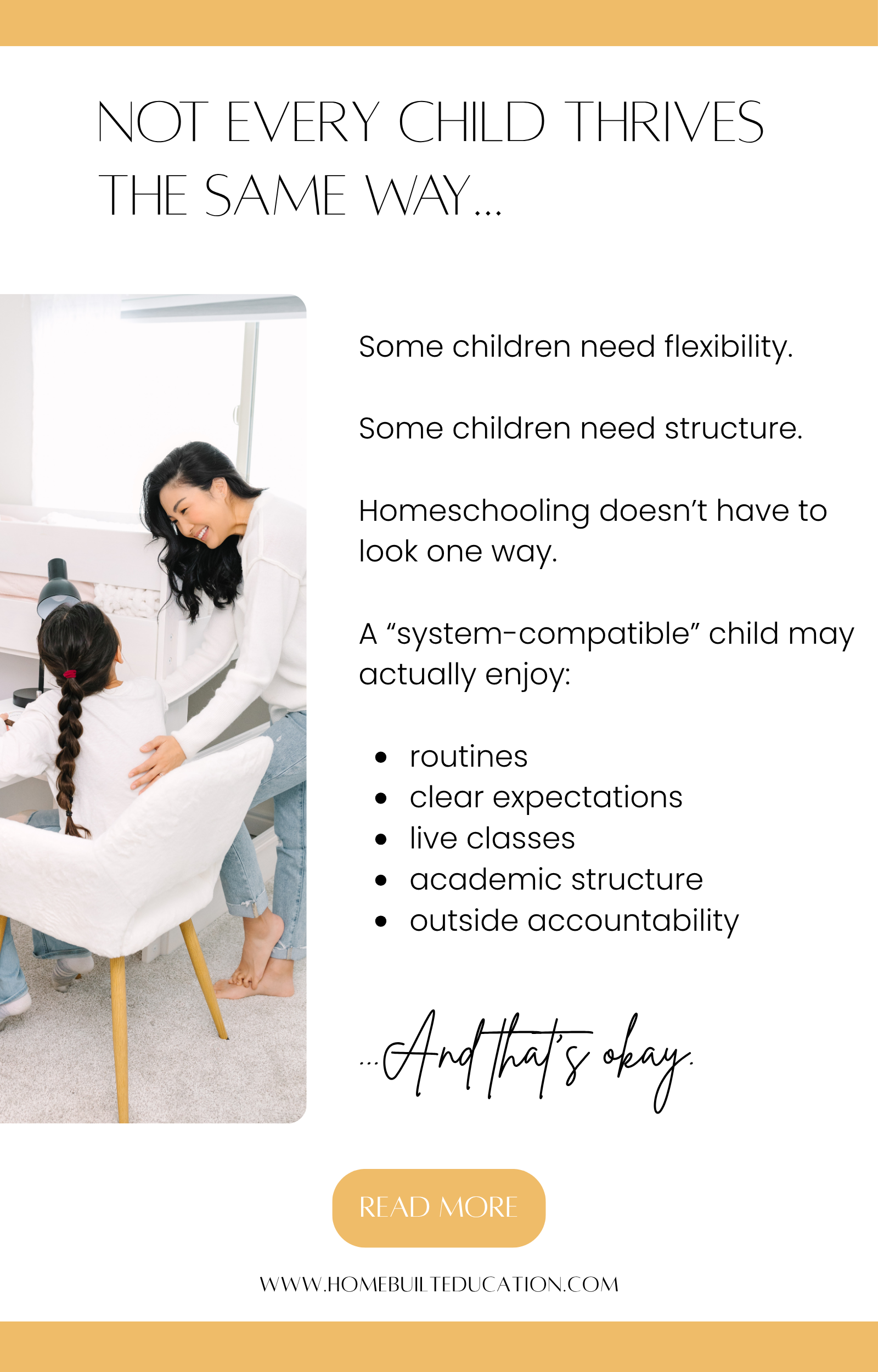
Some children are system-dependent. They rely on rigid external structures because they have never had the chance to build ownership. When that structure is removed, everything unravels.
But there are also children who are system-compatible.
They can think, grow, and adapt. But they still benefit from a strong framework. They appreciate clear expectations, consistent instruction, and a path that allows them to move forward without having to design every piece of it themselves.
That is not a weakness. It is a learning style.
And when we ignore that, we don’t create freedom—we create friction.
What this actually means for you as a parent
If you have a child like this, the question begins to shift.
It’s no longer, Can I homeschool? It becomes, What kind of structure does my child need to learn?
Removing structure entirely can feel just as misaligned as forcing a child into one that doesn’t fit. And this is where many parents get stuck, believing their only options are to stay in a traditional system that may not fully serve their child—or to leave and carry the full weight of building everything themselves.
But that’s not the full picture.
What you can do instead
There are more options than most parents have been shown.
You can build your own structure at home—creating clear expectations, consistent rhythms, and accountability while still maintaining flexibility. You can piece together support by outsourcing certain subjects, bringing in tutors, joining co-ops, or layering programs that give your child both independence and direction.
Or, you can look for something that already holds that balance for you.
Something that offers structure without rigidity, accountability without pressure, and flexibility without losing momentum.
That’s where we found ourselves—not looking for less, but looking for better alignment.
What this year required from us
This is where the conversation shifted for our family.
Not around curriculum in the traditional sense, but around alignment—around paying attention to who our child actually is, especially at this stage.
High school is not the time to build from guesswork. It is not the time to chase an ideal version of homeschooling that doesn’t match the learner in front of you. It is the time to get honest about what is working, what is not, and what needs to change.
That is why this year, we are choosing differently.
And for this season, this child, and this stage, homeschooling online is the right fit..
Why we’re trying something different this year
What we needed became very clear.
We needed consistency that didn’t depend entirely on me. We needed accountability that felt appropriate for high school. We needed a structure strong enough to support serious academics without taking over our entire life. And we needed flexibility—not in the sense of “anything goes,” but in the sense that learning could still fit around who our daughter is becoming.
That combination is harder to find than people realize, because most options force you into a trade-off. You either get structure and lose flexibility, or you get freedom and carry the full weight of building everything yourself.
We weren’t willing to choose between the two.
That’s why this year, we are using Crimson Global Academy.

Why CGA fits this stage
What stood out to me first is that this isn’t a homeschool program that’s just passive or pieced together.
There are live, teacher-led classes where students are actively engaged in their learning. There are opportunities for one-on-one support when needed, and self-paced elements that allow for flexibility without removing expectations.
There is structure—but it isn’t rigid.
My daughter knows what’s expected of her. She has homeschool teachers, coursework, deadlines, and a clear path forward. At the same time, she can rewatch lessons, adjust her pace when needed, and build her days in a way that still allows her to live a full life outside of school.
That balance is what makes this work—and at the high school level, that matters.
CGA also offers a full academic pathway, including U.S. diploma options and Advanced Placement courses. This isn’t something we’re piecing together or hoping translates later. It’s structured, recognized, and aligned with where she may want to go next.
For a student who benefits from both structure and flexibility, this is what fits.
Why we’re choosing this for her
At the end of the day, this decision isn’t about a homeschool program. It’s about a child.
A high schooler who is capable, driven, and still benefits from a clear structure. A learner who doesn’t need less expectation, but the right kind of expectation.
This gives her both—structure that supports her, flexibility that allows her to live, and academics that move her forward.
That’s what we were looking for.
Follow along with us
I know this isn’t a one-size-fits-all decision, and I’m not sharing this as the answer.
I’m sharing it because I know how many parents are sitting in this tension—trying to figure out what their child actually needs, especially at this stage.
We’re stepping into something new this year, and I’ll be sharing what’s working, what’s not, and what we’re learning along the way.
Because this is what homeschooling actually looks like—not one path, not one method, but the freedom to build something that fits.
Final thought
Not every child thrives in total freedom, and not every child needs to build everything from scratch. Some children need a structure they can stand inside without disappearing.
And homeschooling gives us the ability to choose that.
Tap to learn more about CGA, and follow our journey on Instagram.
